|
Agenda Item
ASR
Control 25-000167 |
||
|
MEETING
DATE: |
03/25/25 |
|
|
legal entity taking action: |
Board
of Supervisors |
|
|
board of supervisors district(s): |
All
Districts |
|
|
SUBMITTING Agency/Department: |
District
Attorney (Approved) |
|
|
Department contact person(s): |
Matthew
Pettit (714) 347-8440 |
|
|
|
Keith
Bogardus (714) 347-0511 |
|

Subject: Approval of State Authorized
Increased Real Estate Fraud Prosecution Fee
|
ceo CONCUR |
County Counsel Review |
Clerk of the Board |
||||||||
|
Concur |
Approved
Resolution to Form |
Public
Hearing |
||||||||
|
|
|
3
Votes Board Majority |
||||||||
|
|
|
|
||||||||
|
Budgeted: N/A |
Current Year
Cost: N/A |
Annual Cost: N/A |
||||||||
|
|
|
|
||||||||
|
Staffing Impact: |
No |
# of Positions: |
Sole Source: N/A |
|||||||
|
Current Fiscal Year Revenue: $492,799
|
||||||||||
|
Prior Board Action: 2/27/2024 #15, 2/23/2021 #5, 2/27/2018
#14, 3/3/2015 #1 |
||||||||||
RECOMMENDED
ACTION(S):
|
1. |
Find that the
proposed fee is Statutorily Exempt from the provisions of the California
Environmental Quality Act (CEQA) pursuant to Section 21080(b)(8) of the
Public Resources Code and Section 15273 of the CEQA Guidelines as the
establishment of modification of rates, fees and charges, which are for the
purpose of meeting operating expenses, including employee wage rates and
fringe benefits, purchasing or leasing supplies, equipment or materials as
set forth herein. |
|
|
2. |
Conduct
a Public Hearing. |
|
|
3. |
Adopt
a Resolution that: |
|
|
|
a. |
Rescinds
Resolution 24-017, effective May 1, 2025, and approves an increase in the
real estate fraud prosecution fee collected by the Orange County
Clerk-Recorder from $3 to $10 on certain specified real estate instruments effective
May 1, 2025 for a three-year term ending April 30, 2028 to provide a
continued funding source to investigate, prosecute and deter real estate
fraud crimes pursuant to California Government Code Section 27388. |
|
|
b. |
Increases the
allocation of the real estate fraud prosecution fee for reimbursement to the
Clerk-Recorder’s Office from five percent to ten percent, and authorizes the
Clerk-Recorder to transfer ninety percent of the fee into the District
Attorney Real Estate Fraud Prosecution Trust Fund. |
|
|
c. |
Finds that the
proposed fee meets the requirement set forth in subdivision (e)(3) of Section
1 of Article XIII C of the California Constitution, and is therefore exempt
from the definition of a tax as used therein. |
|
|
d. |
Finds that the
fee bears a fair or reasonable relationship to the payor’s burdens on, or
benefits received from, the applicable governmental services and the revenue
resulting from the fee established under the resolution will not exceed the
estimated reasonable cost to provide these services. |
|
|
e. |
Authorizes the
Clerk-Recorder to collect the additional fees on behalf of Orange County. |
SUMMARY:
Increasing the current real estate fraud
prosecution fee from $3 to $10 will better cover the costs of investigating and
prosecuting real estate fraud crimes in Orange County and help protect
homeowners from financial losses.
Increasing the Clerk-Recorder’s maximum
reimbursable share of this real estate fraud prosecution fee from five percent
to ten percent as authorized by Government Code Section 27388, will recover the
costs of real estate fraud detection efforts administered by the
Clerk-Recorder.
BACKGROUND
INFORMATION:
On March 3, 2009, by Resolution No.
09-020, the Board of Supervisors (Board) authorized: 1) the establishment of
the Real Estate Fraud Prosecution Fund 12G to implement the provisions of
California Government Code Section 27388 to collect a $3 real estate fraud
prosecution fee on specified real estate instruments for the sole purpose of
enhancing the capacity of local efforts to investigate, prosecute and deter
real estate fraud crimes; 2) the Clerk-Recorder to begin collection of the fee
on April 13, 2009; and 3) the establishment of the Real Estate Fraud
Prosecution Committee composed of the County Executive Officer, the
Clerk-Recorder and the Orange County District Attorney (OCDA) to distribute
funds from the Real Estate Fraud Prosecution Fund 12G.
In response, the OCDA, in partnership with
the Clerk-Recorder, established a Real Estate Fraud Prosecution Program that is
funded (in part) by this $3 real estate fraud prosecution fee. The real estate
fraud prosecution fee is a one-time fee borne by and benefitting those who use
the government resource: it is paid, as part of a real estate transaction, by
an individual or entity recording a document relating to real estate. This is
the exact group that enjoys the advantages of having a dedicated Real Estate
Fraud Prosecution Unit to combat real estate fraud crime across Orange County.
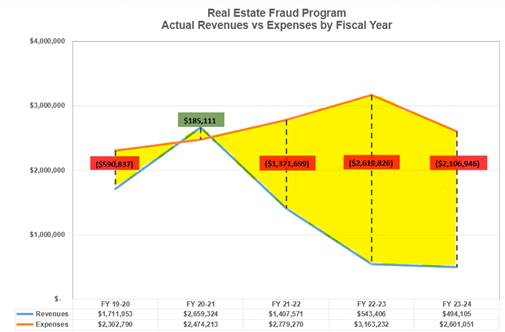
However, the current $3 real estate fraud
prosecution fee is not providing full cost recovery, leaving a significant
portion of program costs to be paid by the general fund (see highlighted
portion of graph below). Increasing the
fee to $10 will allow the continued investigation and prosecution of real
estate fraud crimes in Orange County. This will help protect homeowners,
including many older residents with significant equity in their homes, from
potentially catastrophic financial losses. Furthermore, OCDA reports to the
Board annually on our program revenue, costs and results, thus ensuring that
the Board can revisit the appropriate fee level on a regular basis.
Since the initial establishment of this
fee, the Board has approved five three-year extensions of the real estate fraud
prosecution fee. Prior Board actions are summarized in the table below.
|
Date |
Action |
|
3/20/2012 |
Adopted Resolution 12-028 extending $3
real estate fraud prosecution fee. |
|
3/3/2015 |
Adopted Resolution 15-010 extending $3
real estate fraud prosecution fee. |
|
2/27/2018 |
Adopted Resolution 18-015 extending $3
real estate fraud prosecution fee. |
|
2/23/2021 |
Adopted Resolution 21-020 extending $3
real estate fraud prosecution fee. |
|
2/27/2024 |
Adopted Resolution 24-017 extending $3
real estate fraud prosecution fee. Approved OCDA’s request to return to the
Board prior to expiration of the three-year time period if the actual costs
of administering the Real Estate Fraud Prosecution Unit exceed the revenue
collected. |
Real estate fraud has proven to be a
significant problem in Orange County, causing considerable harm and potentially
catastrophic financial losses for Orange County property owners. The Real
Estate Fraud Prosecution Unit is the primary law enforcement actor fighting
these crimes in the county. The unit is
comprised of prosecutors, investigators and support staff with specialized
training and expertise in real estate fraud that enables them to effectively
investigate and prosecute real estate crimes. The Real Estate Fraud Prosecution
Unit handles an average of 100 reports of potential real estate fraud each
year.
The cases that are reported directly to
the Real Estate Fraud Prosecution Unit represent the vast majority of reported
real estate crime in Orange County. They also represent a serious criminal
threat to our local communities, with potential losses in the tens of millions
of dollars. In addition, real estate fraud cases are often referred to the Real
Estate Fraud Prosecution Unit from other law enforcement agencies. Over the
past three years, the Real Estate Fraud Prosecution Unit has worked closely
with local law enforcement partners, providing trainings and resources to local
agencies to ensure perpetrators of real estate fraud will be brought to justice
regardless of where those crimes are reported. Additionally, the Real Estate
Fraud Prosecution Unit is active in the community, meeting with concerned
groups, such as senior citizens and real estate professionals, to provide
insight and education for identifying, avoiding, combatting, and reporting real
estate fraud.
Two other key innovations made possible by
the real estate fraud prosecution fee and establishment of the Real Estate
Fraud Prosecution Fund are the Courtesy Notice program and the Real Estate
Fraud Prosecution Unit’s direct reporting portal. The innovative Courtesy
Notice program alerts homeowners via mail any time a document affecting title
to their property is recorded. This
system quickly notifies homeowners to changes made to their property title,
which in turn allows them to discover and report any fraudulent activity to the
OCDA without delay. The direct reporting mechanism allows potential victims of
or witnesses to real estate crimes to report directly to the Real Estate Fraud
Prosecution Unit for further investigation. This direct portal allows crime
victims to quickly reach subject matter experts who assess, investigate, and
prosecute these crimes.
Currently, investigators with the Real
Estate Fraud Prosecution Unit are actively investigating approximately 45 real
estate fraud cases. The attorneys are prosecuting approximately 20 filed felony
real estate fraud cases in which approximately 35 defendants are charged. In addition, real estate fraud cases also
require significant litigation even after obtaining a conviction. The Real
Estate Fraud Prosecution Unit is actively litigating four post-conviction cases
involving five defendants. Real estate fraud cases typically have tens of
thousands of pages of discovery, plus voluminous digital evidence. In addition,
the total restitution owed to victims in real estate fraud cases is often over
a million dollars. As a result of the
Real Estate Fraud Prosecution Unit’s efforts, over $27 million in restitution
orders have been awarded to real estate fraud victims in the last three years.
As one may deduce from these numbers, these cases are among the largest and
most complex cases the OCDA prosecutes, requiring extensive and sophisticated
litigation both before and after conviction.
These efforts to obtain justice for Orange
County real estate fraud victims have been made possible by the real estate
fraud prosecution fee. At the time it was first adopted in 2009, Orange
County’s $3 real estate fraud prosecution fee was the highest allowable fee
permitted by Government Code Section 27388; and in 2009, that $3 fee generally
covered the costs of the Real Estate Fraud Prosecution Program. However, over
the past few years, the housing market has seen significant inventory decline
because of rising interest rates. As a result, significantly fewer real estate
documents are being recorded, which means less revenue for the Program. On the
other hand, Program expenses have increased slightly year over year for the
past 15 years since the $3 fee was first adopted. As a result, the Real Estate
Fraud Prosecution Program has been underfunded for the past several years, with
a chasm between program revenues and expenses.
Additionally, home prices have risen
substantially since the Program was implemented. In August of 2009, the median
sales price of a home in Orange County was $427,750 according to data provided
by the County Executive Office in the FY 2009-10 Adopted Budget. By June of
2024, the CEO’s FY 2024-25 Annual Budget reported that the median home price in
Orange County had more than tripled to $1,450,000. Thus, the relative value of
the $3 real estate fraud prosecution fee has decreased by approximately 70%
since the fee was adopted in 2009.
|
Year |
Median Orange County Home Sales Price |
$3 Fee in Relation to the Median Cost
of a Home in Orange County |
|
August 2009 |
$
427,750 |
0.00070% |
|
June 2024 |
$
1,450,000 |
0.00021% |
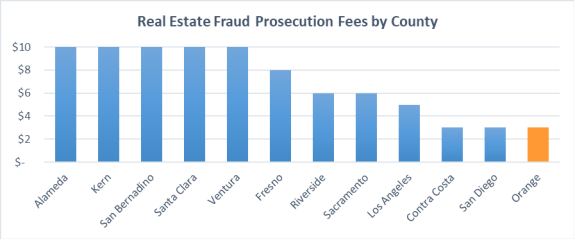
In 2012, Government Code Section 27388 was
amended to allow counties to increase the fee up to $10. California’s counties
have overwhelmingly opted to increase the fees. Among California’s twelve most
populous counties, nine have chosen to raise the real estate fraud prosecution
fee. Only Orange County, San Diego County, and Contra Costa County elected to
stay at the $3 level.
It is also worth noting that many counties
outside of the twelve largest counties have also chosen to raise the real
estate fraud prosecution fee to support real estate fraud investigation and
prosecution. Santa Barbara, Solano, and Marin Counties have all elected to
raise the fee to the $10 level. San Luis Obispo, Monterey, and San Joaquin have
each opted for fees in the $6 to $8 dollar range.
Government Code Section 27388 also
explicitly contemplates the reimbursement of the county recorder’s office for
their actual and reasonable administrative costs incurred in implementing the
Real Estate Fraud Prosecution Program. While the statute permits deductions of
up to ten percent of the fees paid pursuant to Government Code Section 27388,
the Orange County Board of Supervisors has capped the amount that can be
deducted to reimburse the Clerk-Recorder at five percent. As a result, the
Clerk-Recorder’s costs have exceeded their reimbursement for several years.
The Orange County Clerk-Recorder’s Office
has been one of the key partners of the OCDA’s Real Estate Fraud Prosecution
Unit in fighting real estate fraud crimes. It is supportive of investigation
and prosecution efforts and directly refers suspected fraudulent recordings to
OCDA for investigation. One example of
this fruitful partnership was a case in which a “Sovereign Citizen” recorded
multiple fraudulent quitclaim deeds on homes in which he had no ownership
interest. The Recorder’s Office recognized this as possible fraud, despite
being statutorily required to accept them for recordation, and alerted OCDA to
this potential crime almost immediately.
The OCDA was then able to quickly investigate and file charges against
that individual.
The Clerk-Recorder additionally plays a
pivotal role in the Real Estate Fraud Prosecution Program by alerting
homeowners to potential fraud by sending a courtesy notice, via USPS, to
homeowners any time a document affecting title to real property is recorded in
Orange County. Criminals engaged in real estate fraud tend to target the
elderly and unsophisticated. The real estate fraud trends in Orange County
suggest the current automatic, mail-based courtesy notice is an irreplaceable
tool for combating real estate crime in the County. In another example, OCDA
successfully investigated and filed criminal charges against an individual who
recorded multiple false documents on a property she previously lost to
foreclosure. OCDA was alerted to the false documents first by the
Clerk-Recorder, who recognized the documents as potentially fraudulent. OCDA
was then separately alerted to one of the two false documents by the subsequent
purchasers of the property, who received a Courtesy Notice in the mail shortly
after closing escrow.
This robust notification program cost the
Clerk-Recorder over $885,000 during Fiscal Year 2023-2024. In contrast, the
total recording volume was down significantly and thus, based on the $3 fee and
5 percent reimbursement, the Clerk-Recorder only received approximately $25,700
in revenues from the fees paid. In conjunction with increasing the fee to more
fully fund the Real Estate Fraud Prosecution Program, increasing the allowable
percentage deducted for reimbursing the Clerk-Recorder’s actual and necessary
administrative costs will also help close the deficits they face.
A one-time fee of $10 to fund a dedicated
law enforcement team to investigate and prosecute real estate crime is a
tremendous value proposition for Orange County property owners. The one-time
fee, if increased from $3 to $10, remains small in the context of real estate
transactions often worth over a million dollars for even the average
transaction. However, a fee increase from $3 to $10 would have a substantial
positive impact on the Real Estate Fraud Prosecution Program’s ability to continue
to investigate, prosecute, and deter real estate fraud in the county. The Real
Estate Fraud Prosecution Program has been running at a deficit for several
years and the additional funding would allow the program to continue to operate
at a high level. In addition, the
Courtesy Notice program, which allows for the early detection of many real
estate crimes, may not remain viable unless these funding deficits are
rectified.
The OCDA and Clerk-Recorder jointly
request Board approval of the increase of the $3 real estate fraud prosecution
fee to $10 on certain real estate instruments such as Grant Deeds, Quitclaim
Deeds, Deeds of Trust, Notices of Default, Notices of Trustee Sale, Trustee's
Deeds Upon Sale, and Mechanics’ Liens, for a three-year period beginning May 1,
2025 following the adoption of the proposed resolution until April 30, 2028
when the fee comes up for renewal again, and in addition, increase the cap on
reimbursement for the Clerk-Recorder from five percent to ten percent of the
total fees collected for the same time period.
The OCDA and the Clerk-Recorder will
continue to evaluate the fee. In the meantime, the OCDA and the Clerk-Recorder
will continue to: (1) be conservative and diligent in calculating the County’s
costs of the Real Estate Fraud Prosecution program; (2) maintain all fee
revenues in the Real Estate Fraud Prosecution Trust Fund as required by
Government Code section 27388; (3) maintain good records regarding how the fee
was calculated and the subsequent costs of the program; and (4) periodically
review and, if necessary, ask the Board to adjust the fee to avoid collecting
excess fees as described above.
This increased fee will provide the OCDA’s
specialized Real Estate Fraud Prosecution Unit with a necessary ongoing funding
source for the next three years to investigate, prosecute and deter real estate
fraud crimes as referenced in the Recommended Actions. Furthermore, this
increased funding will ensure the joint efforts of the OCDA and
Clerk-Recorder’s Courtesy Notice program – an important tool for combating real
estate fraud in the county – will continue.
Compliance with Proposition 26
The proposed fee does not fall within the
definition of a “Tax” under Proposition 26 because it is excepted by California
Constitution Article XIII C, Section 1, Subdivision (e)(3). Subdivision (e)(3)
excepts from the definition of tax, “a charge imposed for the reasonable
regulatory costs to a local government for issuing licenses and permits,
performing investigations, inspections, and audits, enforcing agricultural
marketing orders, and the administrative enforcement and adjudication thereof.”
This exception applies because the real estate fraud prosecution fees allocated
to the Real Estate Fraud Prosecution Program qualify as a statutory fee for the
deterrence, investigation, and prosecution of real estate fraud crimes. The
increased fees do not exceed the reasonable costs to the County for the Real
Estate Fraud Prosecution Program.
Compliance with CEQA
The subject activity is statutorily exempt
from review under CEQA pursuant to Public Resources Code Section 21080(b)(8)
and CEQA Guidelines Section 15273 as CEQA does not apply to the establishment
or modification of rates, fees and charges that are for the purpose of meeting
operating expenses, including staff wage rates and fringe benefits, purchasing
or leasing supplies, equipment or materials. The subject activity proposes to
modify fees and charges for the purpose of meeting operating expenses and does
not authorize any changes that could reasonably cause any physical change in
the environment either directly or indirectly.
FINANCIAL
IMPACT:
The revenue for the Real Estate
Fraud Prosecution fee is included in the District Attorney’s FY 2025-26 Budget,
in the Real Estate Prosecution Fund 12G. This revenue will continue to be
included in the budgeting process for future years and reflect the Real Estate
Fraud Prosecution fee increase from $3 to $10, upon Board approval.
STAFFING
IMPACT:
N/A
REVIEWING
AGENCIES:
Clerk-Recorder
ATTACHMENT(S):
Attachment
A - Government Code Section 27388
Attachment B - Penal Code Section 115
Attachment C - Penal Code Sections 368 and 487
Attachment D - Real Estate Fraud Prosecution Fee - Draft Board Resolution
Attachment E - District Attorney Fee Checklist
Attachment F - Clerk-Recorder Fee Checklist
Attachment G - Notice of Public Hearing
Attachment H - Summary of Cases